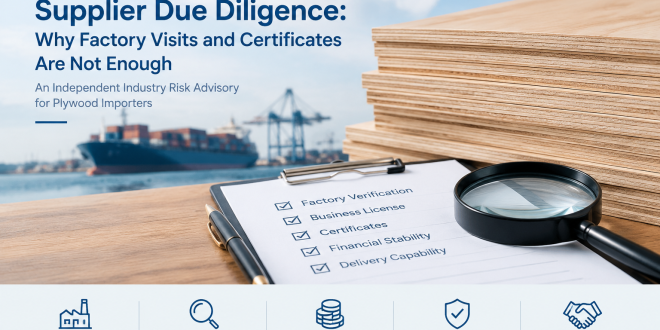

An Independent Industry Risk Advisory for Plywood Importers
Personal Professional Commentary | October 2026
1. Why I Am Sharing This Advisory
Through my work in third-party inspection and sourcing services, I have had opportunities to visit plywood factories, communicate with exporters, and introduce potential suppliers to importers. On some occasions, I have shared supplier contacts free of charge to help buyers explore potential sourcing opportunities.
My intention is to help importers make informed purchasing decisions and identify suppliers that may meet their requirements.
However, an important principle deserves greater attention:
Introducing a supplier does not mean guaranteeing that supplier’s financial condition, business reputation, production capacity, or future delivery performance.
This article is intended to raise awareness of general commercial risks in the birch plywood supply chain. It is not directed at any particular company, factory, exporter, trading company, or country.
2. More Suppliers Are Appearing in the Market. Verification Matters.
The birch plywood market includes businesses with different operating models. These may include established manufacturers, newly established factories, export companies working with independent manufacturers, and trading companies sourcing products from existing production facilities.
The appearance of a company in the market does not, by itself, establish when its operations began, whether it owns manufacturing facilities, or whether it has sufficient resources to fulfil its contractual commitments.
A trading company is not necessarily an unreliable supplier. Likewise, a company that owns or operates a factory is not automatically financially secure or capable of fulfilling every order on time.
Before entering into a transaction, buyers should establish:
- Which legal entity will sign the contract and receive payment.
- Whether the supplier owns the factory, operates it, or purchases products from another manufacturer.
- Who is responsible for production, quality control, and shipment.
- Whether the supplier has sufficient working capital and access to raw materials for the specific order.
- Whether the stated production capacity and delivery schedule can be independently verified.
Understanding the actual business model is an essential part of supplier due diligence.
3. A Factory Visit Is Important, but It Cannot Answer Every Question
Factory visits can provide valuable information about production processes, machinery, available inventory, staffing, and quality-control procedures.
However, a factory visit only reflects the conditions observed at a particular time and within the scope of the inspection.
It does not automatically establish:
- The company’s current financial position or available working capital.
- Its ability to finance raw material purchases for a new order.
- Whether its production capacity can be sustained throughout the contract period.
- Whether other contractual commitments could affect the agreed delivery date.
- Whether the contracting entity will remain financially capable throughout production and shipment.
A genuine factory may operate separately from the company that signs the export contract. The manufacturer, exporter, and payment beneficiary may be different legal entities, each with different responsibilities and financial circumstances.
Buyers should therefore distinguish between verifying that a factory exists and establishing whether the actual contracting party can fulfil a particular purchase order.
A factory visit provides evidence of observed conditions. It is not a guarantee of future performance.
4. Certificates Do Not Guarantee Commercial Reliability
Certificates and regulatory documents may be important, but their significance depends on their authenticity, scope, validity, and applicability.
For example, EPA-related requirements and CARB-related compliance documentation may be relevant to certain composite wood products supplied to the United States. However, the existence of such documentation does not, by itself, establish that a company:
- Owns or operates a genuine manufacturing facility.
- Has sufficient financial resources to complete an order.
- Has a strong credit history or a reliable payment record.
- Can maintain consistent production and product quality.
- Will deliver goods within the agreed timeframe.
Company registration documents, factory audit reports, product test reports, and management-system certificates also address different questions. None should automatically be treated as a comprehensive assessment of a supplier’s commercial reliability.
Before relying on any document, buyers should consider verifying:
- Whether the document is authentic and currently valid.
- Which legal entity it identifies.
- Which products, facilities, or activities it covers.
- Whether the issuing organisation or relevant official database can confirm it.
- Whether the document is relevant to the specific transaction.
Regulatory compliance, product conformity, company identity, and financial reliability are separate matters.
5. Advance Payments Require Careful Risk Assessment
Payment practices vary between suppliers, countries, products, and market conditions.
Based on my professional observations and industry discussions, some buyers have previously encountered supply arrangements that did not require advance deposits. In other transactions, suppliers have requested deposits to support raw material procurement and production expenses.
These observations should not be interpreted as verified statistics representing the entire birch plywood industry.
Nevertheless, when a supplier requests an advance payment, particularly a substantial deposit, buyers should carefully assess their financial exposure before transferring funds.
Even a genuine manufacturer may experience cash-flow difficulties, raw material shortages, production interruptions, or other circumstances that affect contractual performance.
In some transactions, suppliers may also request payment of the outstanding balance after providing a copy of the bill of lading.
Buyers should establish in advance what the relevant shipping documents demonstrate and whether the agreed payment conditions adequately protect their interests. A copy of a bill of lading alone does not establish that the goods meet every contractual requirement, that all contractual obligations have been fulfilled, or that legal title has transferred to the buyer.
Depending on the transaction, buyers may consider:
- Independently verifying the contracting entity and payment beneficiary.
- Using staged payments linked to clearly defined milestones.
- Arranging independent pre-shipment inspections.
- Considering documentary letters of credit or other appropriate banking arrangements.
- Including clear contractual provisions covering delays, non-shipment, refunds, and dispute resolution.
No payment arrangement eliminates every risk. The objective is to identify, reduce, and appropriately allocate risks before funds are transferred.
6. Five Questions to Ask Before Paying a Deposit
Before making an advance payment for a birch plywood order, buyers should consider the following questions.
1. Legal identity: Have we independently verified the legal entity that will sign the contract and receive our payment?
2. Business model: Have we established whether the supplier manufactures the products itself or relies on another factory?
3. Production capability: Is there credible, current evidence that the supplier can fulfil our specific order within the agreed timeframe?
4. Financial exposure: Have we assessed the risks associated with the requested deposit and the supplier’s ability to complete production?
5. Contractual protection: Are the payment milestones, shipment requirements, inspection arrangements, and remedies for non-performance clearly documented?
If material questions remain unanswered, consider obtaining further independent verification before proceeding.
7. Supplier Introductions Are Not Guarantees
In the course of sourcing work, a professional may introduce buyers to manufacturers or exporters previously visited, contacted, or encountered through business networks.
Such introductions can help buyers identify potential suppliers, but they should not be interpreted as guarantees of a supplier’s current financial position, creditworthiness, product quality, delivery performance, or ability to complete a future transaction.
A supplier’s circumstances may change after a factory visit, document review, or previous successful transaction.
For significant purchase orders, buyers should conduct due diligence proportionate to the transaction’s value and risk. Depending on the circumstances, this may include obtaining updated financial or credit information where lawfully available, confirming current production arrangements, checking verifiable trade references, and arranging independent inspections.
A previous supplier assessment should not automatically be treated as confirmation of the supplier’s current condition.
The purpose of an introduction is to facilitate further evaluation, not to replace the buyer’s own decision-making process.
Important Disclaimer: Scope and Limitations
This article is published in my personal professional capacity in connection with my work in third-party inspection and sourcing services.
It is intended solely for general business information and risk awareness. It is not a report concerning any identified company, a credit rating, a financial audit, a legal opinion, or a guarantee of any supplier’s performance.
Any supplier introduction or contact information I share is intended to help buyers conduct their own commercial evaluation. Unless expressly agreed otherwise in a separate written agreement, an introduction should not be interpreted as a guarantee of a supplier’s identity, ownership structure, financial condition, creditworthiness, production capacity, product quality, regulatory compliance, or future contractual performance.
Where I have personally visited a facility, my observations are limited to the date, circumstances, and scope of that visit. Where I have reviewed documents, my conclusions are limited to the materials and verification procedures actually examined or undertaken. Neither should be interpreted as confirmation of matters that were not independently verified.
Each buyer remains responsible for conducting appropriate due diligence before entering into a contract or transferring funds. Buyers should independently verify relevant information, establish suitable contractual and payment safeguards, and seek qualified legal, financial, or international trade advice where appropriate.
This article does not, by itself, create or expand any agency, partnership, guarantee, fiduciary duty, or other legal relationship between the author and any buyer or supplier. Any such relationship or responsibility must be determined by the relevant facts, applicable law, and specific agreements.
Nothing in this disclaimer is intended to exclude or limit any liability that cannot lawfully be excluded or limited under applicable law.
The opinions expressed are my personal professional commentary as of the publication date. Information that has not been independently verified should not be treated as established fact. The views expressed may be revised if new information or circumstances warrant a change.
Final Thoughts
The purpose of supplier due diligence is not to undermine confidence in the plywood industry. It is to help buyers make informed decisions, protect their capital, and build sustainable supply relationships.
A factory visit is valuable. A valid certificate is valuable. A positive trade reference is valuable.
But none of these, individually, constitutes a comprehensive guarantee of future performance.
Verify the legal entity. Understand the business model. Assess the financial exposure. Protect your payment. Make informed sourcing decisions.